
Ambulance Commission weighs shift to ALS service
Greenwood representative airs grievances, leaves meeting
TOWER- Members of the Tower Ambulance Commission looked at ways of moving to a higher level of emergency care, called Advanced Life Support, at their quarterly meeting on April 4, but not before the …
This item is available in full to subscribers.
Attention subscribers
To continue reading, you will need to either log in to your subscriber account, below, or purchase a new subscription.
Please log in to continue |
Ambulance Commission weighs shift to ALS service
Greenwood representative airs grievances, leaves meeting
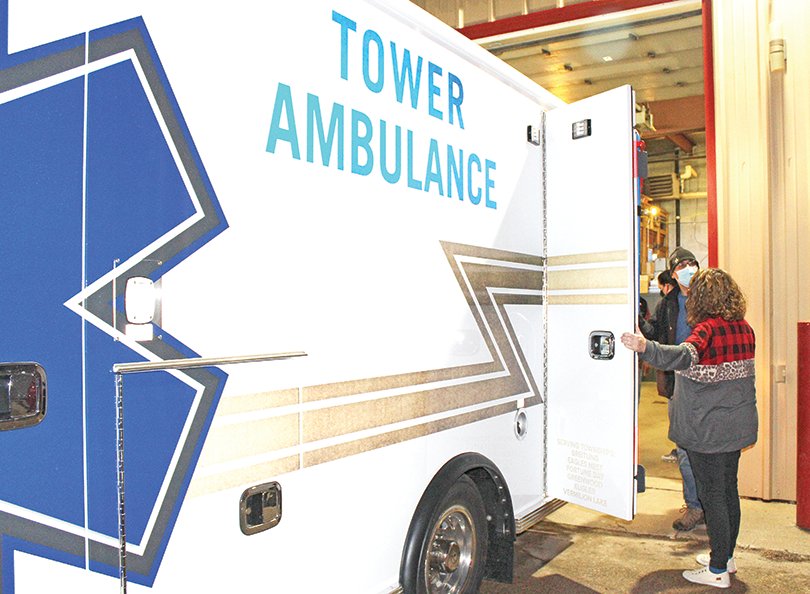
TOWER- Members of the Tower Ambulance Commission looked at ways of moving to a higher level of emergency care, called Advanced Life Support, at their quarterly meeting on April 4, but not before the newly appointed representative from Greenwood Township immediately aired some complaints and then abruptly left shortly after the meeting started.
The commission was established to deal with the purchase of new ambulances, but in recent years has seen itself in a more advisory role as the ambulance service has struggled with financial issues. The commission includes one member each from the city, Bois Forte Band, and the townships in the state-mandated ambulance service area.
Before the commission had even approved its agenda, newly appointed Greenwood representative Rick Stoehr began asking questions about financial issues. Then he asked about funds a Tower city audit had shown to be taken from the ambulance service’s operating fund in previous years.
Tower Mayor Dave Setterberg, who was in attendance but does not sit on the commission, said the city was still reviewing the information.
“We still don’t know what the total is,” Setterberg said. “We are working on this.”
Eagles Nest representative Larry McCray reminded Stoehr that the commission’s job was to oversee rig replacement.
Ambulance Supervisor Dena Suihkonen repeated that none of the possibly transferred money was from the rig replacement fund.
“I made a commitment to the people of Greenwood to serve in their best interests,” said Stoehr. “It is unfortunate that you folks are having the troubles you are. We are glad to work with you, but I can’t commit to anything now.”
Stoehr also was upset with the draft ambulance subsidy agreement contract for 2022 that made changes to an indemnity clause that was inserted at the request of Greenwood Township last year.
“Greenwood Township paid a lot of money for the indemnity clause,” Stoehr said.
Tower commission representative Kevin Norby said that the city attorney wanted changes to the clause and said the two attorneys could talk to each other to resolve the issue. The city’s attorney felt the clause was too broad, and assigned too much responsibility to the city, even for liability that might not be directly related to ambulance personnel on scene. The city put forth draft language that called for mutual indemnification. The agreement also calls for the city itself to maintain general liability insurance for its services and to include the townships and Band as additional insured. The contract was presented as a draft, not as a final document.
Greenwood resident Lee Peterson, a frequent ambulance service critic, then asked why the ambulance service had not presented a business plan to the commission, something it had planned to do last year.
Peterson was told there was to be no public comment at the meeting, and at that point, both Peterson and Stoehr left.
After Stoehr was gone, Setterberg noted that the business plan that the city has been working on, with some outside assistance, was almost ready for review.
Serious discussions
Commission members, minus Stoehr, then jumped into a long discussion of issues related to the ambulance service.
The service is facing multiple challenges right now, including:
• Affording a new ambulance.
• Financing the cost of paid on-call staffing 24/7.
• Increasing the level of care provided (ALS service with paramedics) to meet demand from an aging population.
On a positive note, Suihkonen said the service is currently well-staffed with both EMTs and EMRs, and also gets support from trained First Responders from Eagles Nest and Greenwood townships.
Suihkonen told the commission her staff is seeing a lot more serious medical calls, including active heart attacks, strokes, and diabetic emergencies.
“Ambulances are great,” she said, “but without people who can work the equipment they are just pieces of metal.”
The service by all accounts has been busy, with a record number of calls the first quarter, and also has logged over 90 percent of its hours with two employees on call. But the push to have the service fully staffed 24/7 has come at a cost, with on-call employees paid $11 per hour, far higher than the on-call rates paid in other small neighboring services.
While the staffing plan has allowed the service to avoid missing calls this year, it is also operating at or below a break-even basis.
“Our balance is low right now,” said Suihkonen. “But we do have $114,570 in the ambulance replacement fund.”
Over 85 percent of the service’s calls are paid through Medicare or Medicaid, which pays a flat rate well below that paid by private insurers. The service has gotten permission to charge a flat $150 rate, paid by Medicare, for calls that only require treatment at the scene, such as a lift assist, and the city has approved raising the rates for private-pay insurance patients as of March of this year.
The service has been analyzing the financial impact of transfer calls, when patients are moved from hospital to hospital, usually when they require a higher level of care. The service will only respond to a transfer if adequate personnel are left in Tower to respond to a 911 call.
The miles put on the ambulances for these non-emergency calls has been an issue with commission members, who have required the city to pay a $1.66 per mile rate back into the ambulance subsidy account for transfer miles logged. This charge has been an additional financial drag on the service’s bottom line. Suihkonen noted the service had not made those payments so far in 2022, because the income is not available. At the current rate of transfers, the fees would total about $20,000 a year from the service’s general fund into the rig replacement account.
Suihkonen said the service is mostly taking transfers that involve local patients and is not doing any long-distance runs. The service has done 14 transfers so far this year.
Moving to Advanced Life Support (ALS)
McCray noted that it was outside the scope of the commission to plan for the future of the service, but said he wanted to put forward some ideas. McCray is a retired firefighter and paramedic, and currently serves as the fire chief in Eagles Nest Township.
He urged the group to look forward, not backward.
“Where are we going to be sitting in three to five years?” he said. “Are we still going to be sitting here figuring out how to go from $15 to $16 per capita, are we still going to be fighting with Tower about the bucks they lost years ago? I am going to be honest. What I am really thinking about is an ALS service and how we get there.”
McCray said such a move would be challenging, both financially and staff-wise. Area ambulance services that provide ALS service have trouble keeping trained paramedics on staff because many leave for better-paying positions in urban areas. Another challenge is reducing response times, which would mean staffing ambulances in other parts of the service area besides Tower.
“It is going to take some thinking out-of-the-box to get there,” he said.
The first step would be the creation of a regional ambulance commission with joint powers authority, he said.
“This would grow the service into something we could all be proud of,” he said.
Funding would need to be done differently also, he said. A small tax levy based on property value would bring in additional revenue, because it wouldn’t be tied to the number of full-time residents.
He said such a move would take the burden away from one city.
“I don’t want to steal anything from Tower,” he said. “But if we want to grow this thing, it needs to be bigger than what the city can generate.”
It would be possible to train the current staff of EMTs to the paramedic level with mostly in-house effort, others said.
The commission members decided to go back to their boards to float the idea of forming a regional commission, and possibly set up a new ad hoc committee to work on the idea.
“We would have more ambulances, better equipment, and could do more rescues,” said Suihkonen. “If we can start fresh, all the old stuff goes away.”
“We need to change the narrative,” said Vermilion Lake representative Frank Zobitz.
Other business
In other business, the commission passed a motion to get requests for information from manufacturers for purchasing a third ambulance with a new chassis, refurbished box, and an auto-load cot. Suihkonen said the earliest an all-new ambulance could be available would be in 2024, but a refurbished model would be available in 2023.
The commission did not seem eager to rescind the requirement of the $1.66 per transfer mile.
“When we are having to pay for 24/7 coverage,” said Suihkonen, “having the transfers helps with money for salary costs.”
She noted that the EMSRB study done on the service last year recommended the discontinuation of that charge, which they said was not seen in other ambulance services they had studied.
“The EMSRB report said the per capita needs to be increased and the $1.66 eliminated,” she said. “It said we need to look at our overall funding for operations, not just capital purchases. If we were all working together to make sure the service is the best it could be, we would be better off than arguing.”
Suihkonen said it does bother her that the service has not been able to afford to pay the $1.66 fee into the account. “We can’t make money out of thin air,” she said.
Norby said the service is running as lean as possible.
“Our people have a lot of pride in their service,” said Suihkonen. “But when people walk out of the meeting without listening…it is people looking down and saying you are not doing enough.”
“We are there for our community,” said Suihkonen. “We need our community to be there for us.”
The next ambulance commission regular meeting was set for Monday, June 27, a week early due to the first Monday falling on the Fourth of July.


