
Voyageurs tasing report clears rangers
REGIONAL — Four years after a controversial confrontation on Lake Kabetogama left Ash River houseboat operator Justin Ebel twice tased by Voyageurs National Park law enforcement rangers, and more …
This item is available in full to subscribers.
Attention subscribers
To continue reading, you will need to either log in to your subscriber account, below, or purchase a new subscription.
Please log in to continue |
Voyageurs tasing report clears rangers
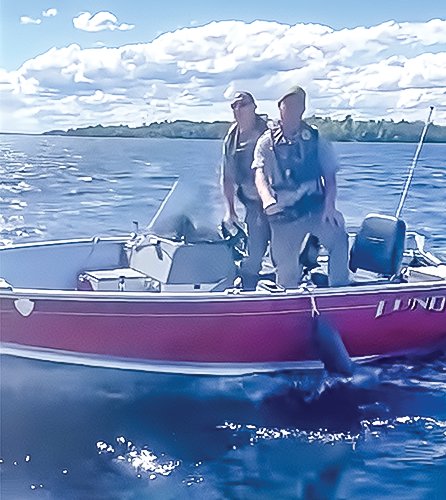
REGIONAL — Four years after a controversial confrontation on Lake Kabetogama left Ash River houseboat operator Justin Ebel twice tased by Voyageurs National Park law enforcement rangers, and more than two years after the Timberjay requested records related to the incident, the National Park Service has released an internal investigation that cleared the rangers of any policy violations.
The Office of Professional Responsibility report, released June 16 in response to a Freedom of Information Act request filed by the Timberjay on March 7, 2024, exonerated both rangers on allegations related to arrest authority, use of force, and violations of the National Park Service code of conduct.
The findings provide the first official public account of the agency’s review of the rangers’ actions in the June 25, 2022 incident, which sparked widespread concern among area residents and businesses and helped fuel public criticism of law enforcement practices at Voyageurs during that period.
The incident began after one of Ebel’s rental houseboats ran aground on a rock near the Ash River Visitor Center. Ebel, owner of Ebel’s Voyageur Houseboats, responded in a service boat to assist the stranded vessel and its occupants, an elderly couple.
According to previous reporting by the Timberjay, Ebel planned to escort the damaged houseboat to Sullivan Bay, where it could be secured and inspected. The confrontation developed after rangers directed the houseboat to turn around and return to open water, a decision Ebel opposed because he believed the vessel and its occupants should first be moved to safety.
The situation escalated after rangers ordered Ebel to stop his service boat and he failed to comply. One ranger ultimately boarded Ebel’s vessel, a struggle ensued, and Ebel was tased twice before being taken into custody.
Federal prosecutors later dismissed most of the citations issued following the incident. Ebel ultimately entered a no contest plea to a single charge of failing to obey a lawful order from a government employee or agent.
The OPR investigation concluded that the rangers acted within their authority throughout the encounter.
Investigators found that the rangers had legal authority to detain Ebel after he repeatedly refused orders to stop his vessel. The report also concluded that the force used during the arrest, including deployment of a Taser, was consistent with National Park Service policy governing use of force.
The report further found no evidence that either ranger violated the agency’s code of conduct.
Yet while the investigation cleared the rangers, the lead investigator acknowledged that the confrontation was not necessarily the only way the encounter could have unfolded.
“While it is my belief that there were other potential avenues or paths that may have allowed for a different outcome in this encounter, that does not inherently mean that the one that [the ranger] chose was incorrect or in opposition to NPS policy,” the investigator wrote.
That observation appears to reflect one of the central disagreements that emerged from the incident.
According to the report and Ebel’s account, the two sides approached the situation with different priorities. Rangers viewed Ebel’s actions as interference with their law enforcement duties, while Ebel remained focused on moving the damaged houseboat and its occupants into sheltered water before any enforcement action occurred.
Interviews conducted by OPR investigators also shed new light on the reasoning behind decisions made by the rangers that day.
The interviews indicate the rangers viewed Ebel as confrontational based on prior contacts, believed he was actively interfering with their investigation, and worried that allowing him to continue toward shore could draw additional people into the situation.
In one interview summary, the investigator wrote that “Ebel is from a community outside the park. The community there has residents who hate the park. One guy (in the community of Ash River) is trouble for the ranger’s every time they contact him and has threatened a female ranger that if she ever boarded his vessel he said, ‘I will kill you.’ The rangers have had a history with this small community (Ash River). This is one of the reasons why [redacted] didn’t want Ebel to go to this community (where he docks his boats). [Redacted] didn’t want Ebel to get on the phone or radio and contact other people to come get help.”
Ebel said the passage was one of the most surprising parts of the report.
“I’m pretty extremely appalled,” Ebel said. “I’ve never heard anything like that in my life, that I’ve been referred to as that, or anybody in our community that has been referred to as wanting to kill somebody for boarding a boat or something like that.”
Ebel said the characterization appeared to reflect a broader perception of Ash River that existed among some law enforcement personnel at the time.
“To be put in this position where there’s an evil community or evil person on Ash River that’s blatantly against them, that’s crazy,” he said. “My business, I’ve been doing my whole life with my parents, from grandparents to parents to me doing it ourselves with my wife, and the Park Service or Voyageurs National Park is basically my bread and butter. Why am I going to mess with that?”
Ebel said he was not surprised by the investigation’s conclusions, although he remains critical of the decisions that led to the confrontation.
He said the incident stemmed from the rangers’ decision to interrupt his efforts to move the damaged houseboat to Sullivan Bay.
According to Ebel, he had already informed the rangers where he intended to take the vessel and had no intention of preventing them from boarding the houseboat once it had been secured.
“They had approached me and said, ‘Thank you for pulling the boat off the rocks,’” Ebel recalled. “Here’s my plan. I’m going to bring them into Sullivan Bay, and I’m going to tie them up for the night.”
Ebel said his frustration began only after rangers directed the houseboat back into open water.
For Ebel, the issue was never whether rangers could board the houseboat.
“I didn’t care if they boarded the boat,” he said. “They can board the boat.”
Instead, he said, his concern was ensuring the safety of his customers and the seaworthiness of the vessel before additional actions were taken.
While disappointed by the outcome of the investigation, Ebel said the law enforcement presence at Voyageurs feels very different today than it did in 2022.
“The interesting thing about the entire situation,” Ebel told the Timberjay this week, “is at the end of the day, the two officers that were involved directly with me that day no longer are here.”
Both rangers involved in the incident have since left Voyageurs, as has former chief law enforcement ranger Josh Wentz, whose tenure became a focal point for criticism from some park users and businesses.
Ebel said his impression is that the park now has fewer full-time law enforcement rangers than it did at the time of the incident, although Voyageurs continues to employ both permanent and seasonal law enforcement staff.
“I hate to say it this way, but it feels like it’s non-existent,” he said.
Ebel said that in the past, rangers assigned to the Kabetogama and Crane Lake areas routinely introduced themselves to local businesses.
“They would stop by and say, ‘Hey, this is who I am,’” Ebel said. “They’d give us their cell number and say, ‘If you need anything, give us a call.’”
Ebel said he hopes future relationships between park law enforcement and local businesses are built on communication and cooperation.
“We’re stakeholders in the community, we should be partners,” Ebel said.
He would like to see more opportunities for law enforcement officers and local businesspeople to get to know one another before problems arise.
“Just more transparency on what’s expected from a community back and forth,” he said.
For Ebel, the release of the report closes a chapter that has remained unresolved publicly for years.
“It was a shitty thing that happened all around,” he said. “But I’m still renting houseboats, doing what I’m doing, doing everything the same, and nobody bothers me anymore.”


